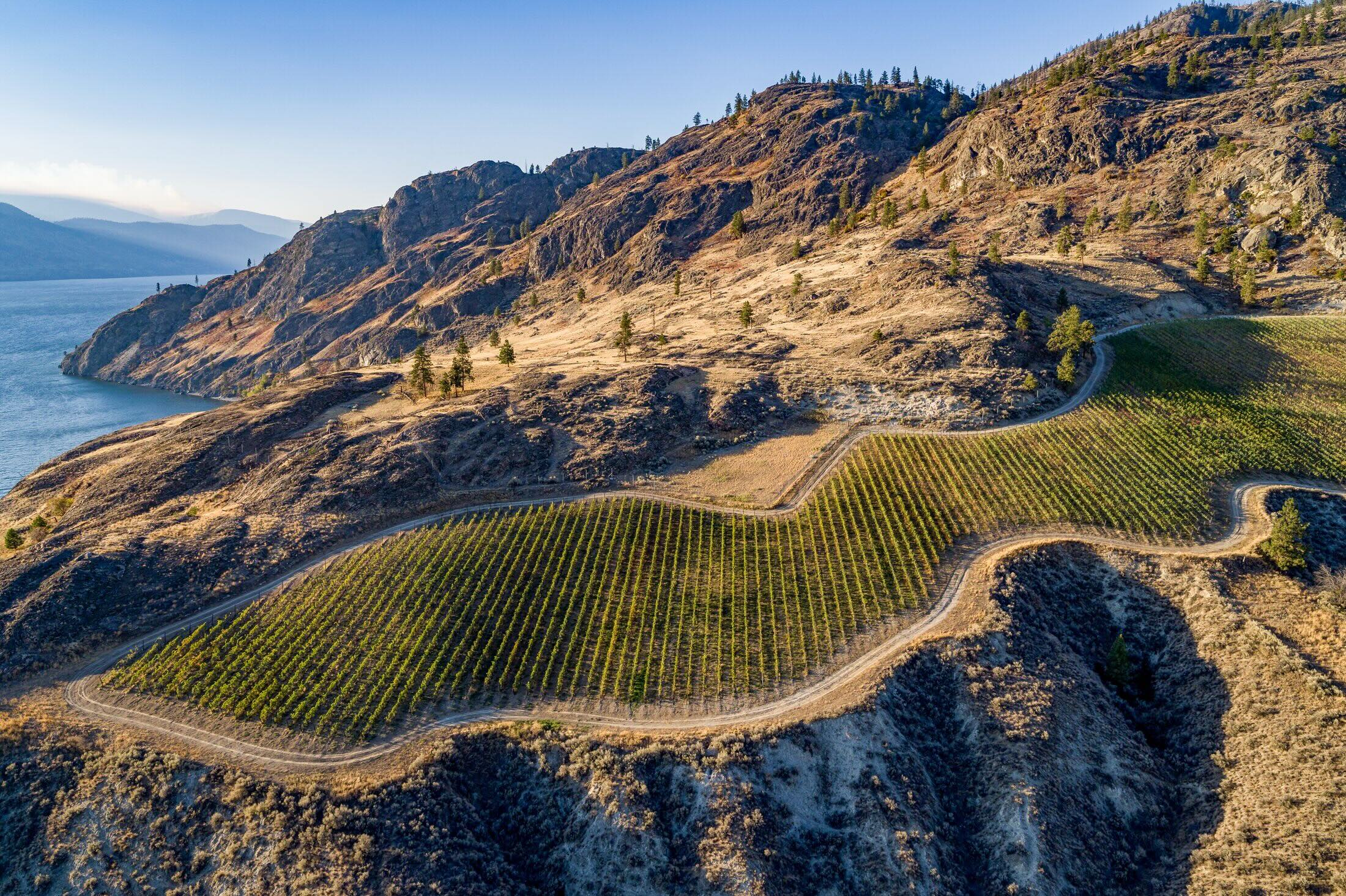
Climate change, with its pattern of extreme weather, has produced complex chains of events and decisions. One of them has led many producers in British Columbia’s Okanagan Valley, among Canada’s most important wine regions, to source grapes from elsewhere, and that in turn has compelled them to navigate complex commercial and political issues.
It all began with two brief periods of very cold weather in the winters of 2022-23 and 2023-24. In December 2022, temperatures below -20°C led to 2023 harvest losses of 60% or more, and the need to replant about a third of the vines. Dylan Roche, winemaker with Pénélope Roche at Roche Wines, says that “the cold spell caused extensive bud damage, but left secondary and tertiary buds mostly intact. The result was a late but full canopy, with 30% of a normal harvest for our vineyards.”
A year later, in January 2024, temperatures fell even lower to -27°C in some places, leading to widespread damage and a harvest wipe-out for many producers – including Roche, which experienced “total crop loss.” Shane Munn, winemaker at Martin’s Lane Winery, which sources grapes from vineyards throughout the Okanagan Valley, describes the event this way: “We were in the middle of an unseasonably warm winter when it plummeted to below -25°C in most of our vineyards. What made it worse was it got colder than the previous winter, it got colder faster, and it stayed at that cold temperature for slightly longer. The result was over 99% bud death in all primary, secondary and tertiary buds.”
The longer-term effects of these events are yet to unfold, but in the short term many wineries are for sale, while others have begun replanting. With effectively no 2024 wine to sell and the need to wait for new vines to mature, the outlook is pretty bleak for the next few years, even though some wineries have stock from earlier vintages to tide them over. As an emergency measure, producers were allowed to make a limited quantity of wine using grapes from outside British Columbia. Many sourced grapes or juice in the United States, especially from Washington (which borders British Columbia) and Oregon; a few looked farther afield, to Ontario, France, and even New Zealand.
Making wine from elsewhere is a way to survive by generating some income, but for wineries whose reputations rest firmly on locally grown grapes – and on wines identified by specific vineyards – it’s a complicated strategy. Roche Wines and Martin’s Lane Winery, both producers of high-quality, single-vineyard wines, bought grapes from carefully selected Oregon vineyards. One of Dylan Roche’s classmates from his studies in Burgundy 20 years ago had helped his family establish their winery in Oregon’s Dundee Hills AVA, and they supplied “top-quality grapes and helped with the key elements of processing.”
For Shane Munn of Martin’s Lane, “essentially our sole purpose was to replicate from Oregon-sourced fruit what we do in the Okanagan Valley – produce single vineyard Pinot Noirs and Rieslings from vineyards grown at least to the standard of our own sites – at a minimum organically grown, some also biodynamic.” He drew up a wish-list of Oregon vineyards and then “it was simple matter of visiting the vineyards, aligning on growing standards, and agreeing to purchase a small volume of fruit.” Both the Roches and Munn visited their Oregon sites several times to check on the fruit in the lead-up to harvest. Then Roche shipped chilled juice to its winery, while Martin’s Lane brought grapes to Canada in refrigerated trucks.
This is possibly unprecedented as a strategy in these circumstances, although it’s quite easy to see that it might become a model for other wine regions that suffer climatic stress. But it’s also important to recognise the strategy does not involve blending Okanagan wines with wines from other regions. This is not like the addition of Rhône Valley Syrah to Bordeaux reds throughout the 1800s and early 1900s to give them colour and depth, especially in challenging vintages. Nor is it like the dubious practices in many regions of France in the phylloxera era, when Spanish and other wines, and wine made from Greek and Turkish raisins, were blended with many French wines – including some of the most prestigious names.
Nor does the Okanagan strategy follow the 1972 example of Ontario, when producers faced a poor harvest and were permitted to blend Ontario wine with imported bulk wine. These blends – using wine from Chile, France, Australia, and elsewhere – remain fixtures of the Ontario wine industry, especially of the large producers. The real issue with these blends is that consumers confuse them with 100% Ontario wine. They are usually less expensive than Ontario wine and they have virtually the same labelling as the local wines of the producers that make them. They far out-sell Ontario wine.
The Okanagan strategy for the 2024 vintage might seem similar, but it is completely different. There is no blending, and most of the producers that make these wines labels them transparently. Labelling might not be so important for sales through a club whose membership implicitly trusts the producer – Martin’s Lane makes all sales to individuals through its mailing list – but it’s critical for wines sold through retail channels.
One premium Okanagan producer, Quails’ Gate Winery, has an independent brand, Plume, for wines made from grapes not grown in the Okanagan Valley. The back label of its 2024 Pinot Gris reads ‘Oregon Grown, Okanagan Made’ and ‘Made in Canada from Oregon grapes’. Roche Wines and Martin’s Lane use their own brands on the wines made from non-Okanagan grapes, but their labelling is clear. Roche, located in the Naramata Bench sub-GI of the Okanagan Valley, labels its Oregon wines, ‘Crafted in Naramata from grapes grown by our friends in the Dundee Hills of Oregon’, and, lower down the label, ‘Made in Canada from Oregon grapes’.
Martin’s Lane has a front label reading, ‘The Oregon Project’, and the same kind of information as appears on its Okanagan Valley wines. An Oregon Riesling is labelled ‘2024 Martin’s Lane HYLAND VINEYARD Riesling, Willamette Valley, Oregon’. The back label tells why and how they embarked on the Oregon project, starting with the cold weather events.
These wines have been well received, but a complication arose early in 2025, just as the first of them were being released: a widespread reaction in Canada against all things American because of President Trump’s tariffs and threats of more, and his persistent talk of making Canada the 51st state of the United States. Because of the tariffs, province-owned alcohol retail stores took American wines and spirits off their shelves, and many restaurants removed them from their lists. Dylan Roche notes that “given the tone of political and economic relations with the USA these days,” they sometimes need to explain why they used Oregon grapes, but “most consumers understand the reasoning behind our choices.” The choices were made, of course, before Trump was re-elected.
It remains to be seen if these wines are one-vintage efforts, because it’s perfectly plausible that cold snaps will reduce or devastate future harvests in the Okanagan Valley. Shane Munn of Martin’s Lane says, “we had always contemplated the idea of making a Pinot Noir, and potentially a Riesling, from another region or country to add some dynamism, for lack of a better word, to our portfolio of existing site-driven wines.”
That strategy might well align with economic necessity, should there be future periods of extreme cold. But over the short term, it is complicated by the continuing anger directed at Trump’s trade policies. Travel by Canadians to the U.S. has fallen sharply, airlines have reduced U.S.-bound flights, and surveys show that many consumers do not intend to resume buying American wine when it returns to the Canadian market. Absent another climate emergency in British Columbia’s vineyards, current feelings towards the U.S. might well make wine produced with American grapes a difficult sell. We shall see.