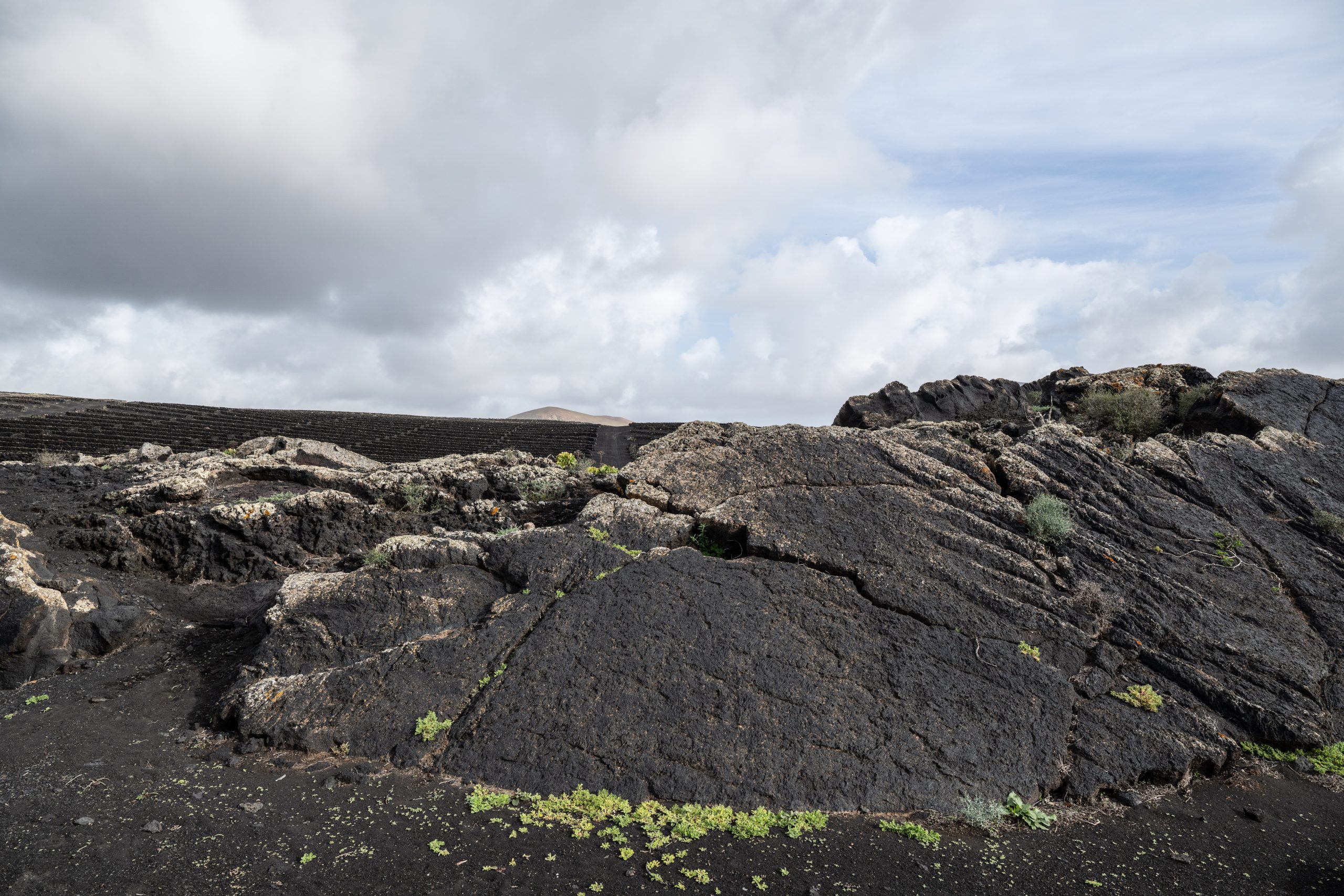
Marta Labanda led me up the steep, black slopes of Barranca del Obispo. Here in Lanzarote, growers cultivate vines in hollows dug out of the granular black volcanic ash. It’s an extraordinary lunar landscape, and brutally hard work: everything is done by hand and yields are tiny. On slopes like this one, where Labanda and her husband Dani Ramírez have revived 200-year-old vines for their Titerok-Akaet wines, it’s an even greater feat. And yet while these conditions are extreme, the pair exemplify the spirit which makes Spain such an exciting wine scene now.
That sense of excitement was tangible at Tim Atkin’s big tasting of Canarian wines in Lanzarote earlier this month. But I’ve seen something similar time and again recently: at the buzzing Barcelona wine week; at last year’s Viñateros tasting in London, showcasing smaller producers from all over Spain; at a local festival in Cambados, capital of Rías Baixas wine country, and meeting producers from Ribera del Duero to Valencia over the past couple of years. There is a dynamism to Spanish winemaking that has few European equivalents (there are parallels in Greece, though on a much smaller scale.)
The contrast to many more traditional regions is glaring. I can’t think of anywhere in France with the kind of buzz to it that, for instance, Sierra de Gredos or the Canaries have now. In Bordeaux, this year’s disastrous en primeur campaign suggests that many wine drinkers have simply moved on. Burgundy’s prices have put serious wines beyond the reach of most. And while I had fun at the Grandi Langhe Piemonte gathering in Turin this January, there wasn’t anything like the kind of innovation you see in Spain. Why is that?
“My theory is that in Spain, the idea of the vigneron (or viñatero) disappeared at some point in the 20th century,” says Ben Henshaw, founder of leading Spanish importer Indigo Wine. “Moreover, most bodegas in the 1990s and 2000s began investing heavily in cellars over vineyards.” But then, he says, “In the mid-2000s, a younger generation was inspired by the likes of Raúl Pérez and Daniel Landi to focus on vineyards and unfashionable or forgotten varietals.”
The locations of those pioneers are telling – Landi in Sierra de Gredos, Pérez in Bierzo. Both areas are mountainous, with a large number of old vines; both were unfashionable, indeed little known. Plus Landi and Pérez, like many of the winemakers they have inspired, had a new stylistic approach. As Henshaw says, “With a less-is-more approach in the cellar, they started making fresher, more refined styles.” It’s often referred to as an “Atlantic” style rather than a “Mediterranean” one, though that shorthand doesn’t capture regional subtleties – or factors like the use of oak.
So in Spain a lot of younger winemakers are employing lower-intervention techniques, using old vines or reviving unfashionable ones: not long ago I tasted a Castilla-La Mancha white made from 83-year-old, high-altitude Airén grapes. They’re working especially in areas that were until recently under-appreciated. And there’s a willingness to take risks. Labanda, from Rioja, and Ramírez met while studying oenology in Tarragona, then came to Ramírez’s native Lanzarote in the summers to make wine in 2017, moving there permanently in 2020 (while having kids). What’s the French equivalent of a Riojana lighting out for a vineyard on a volcano?
Or take Fil.loxera, the project of husband-and-wife team Pilar Esteve and José Doménech, in the far south of the Valencia DO. They have revived several virtually extinct local grapes, such as Arco, patiently nursing small, abandoned vineyards back to life. Theirs are literally garage wines: made in tubs in their back yard and matured in barriques stacked perilously in their garage, surrounded by kids’ bikes and sports’ equipment.
It helps that there is a little more regulatory freedom in Spain compared to France. Spain’s DO disposiciones reguladoras rulebooks are not centrally administered in the way France’s equivalent cahiers des charges are, and not as strictly enforced. One new-wave Rioja producer cheerfully admitted to me that he puts up to 40% white grapes in some of his reds, in defiance of the rules.
More than that, there is simply less weight of tradition than in France. “Bordeaux found their winning formula and then stuck with it,” Paco González of Bodegas Murviedro told me when I visited Utiel-Requena, west of Valencia. But even a relatively well-established DO like theirs was still selling almost all its wine in bulk only 25 years ago: “‘This region is a work in progress – it’s still developing its identity.” That gives winemakers more freedom. Even Ribera del Duero, Vega Sicilia aside, has barely half a century of making serious wine.
Of course there are also oceans of undistinguished plonk made in Spain: it remains Europe’s largest source of bulk wines. Low labour costs – and that of land too, in places – are also a factor.
Yet at the same time, Spain has tradition too, and while Rioja faces serious challenges with falling demand, a new wave of winemakers are now asserting themselves. Some of the most inspiring visits I’ve done in the past couple of years have been with terroir-focussed producers such as Tentenublo’s Roberto Oliván and Maisulan’s Eva Fernández, both in Rioja Alavesa.
Meanwhile many traditional producers offer incredible value. Just this week, the Wine Society has made Spain the focus of a new fine wine campaign. Where else in Europe could you buy mature classics such as Urbina’s Gran Reserva 2004 for £26? As for the amazing CVNE Imperial Gran Reserva Rioja 1960, I confess I don’t have £335 to spend – but if I did, I wouldn’t get fractionally close to that level of serious old wine in Bordeaux.
I admit, as a Hispanophile, that I’m biased: Spain’s food, people and language seduce me too. But there is no denying the dynamism or Spain’s current wine revolution – and others could learn from it.
Andrew Neather blogs at https://aviewfrommytable.substack.com/. His new book with Jane Masters MW, Rooted in Change: The Stories Behind Sustainable Wine, is published 1 October by the Académie du Vin Library.
Photo of Lanzarote by Tim Atkin MW