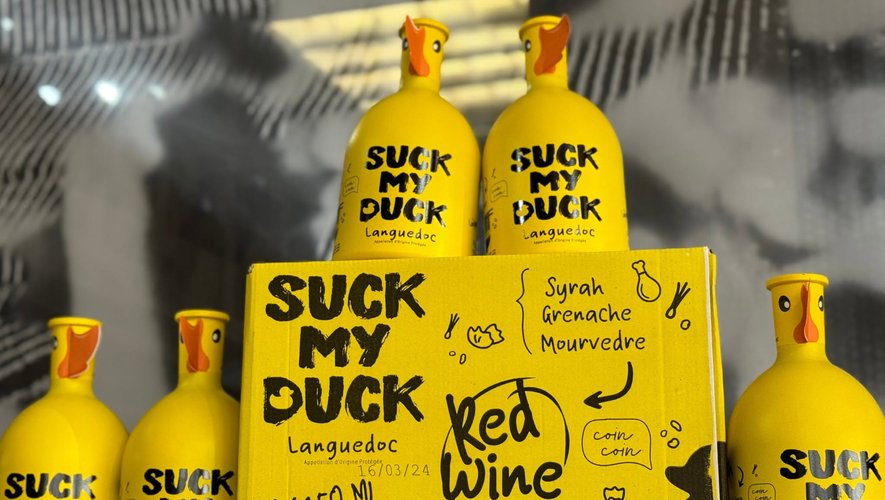
Never say that wine labelling regulations are a subject devoid of humour. The Tribunal Correctionnel de Paris recently heard a case brought by anti-alcohol NGO Addictions France against Languedoc vigneron Nicolas Vellas over his provocative packaging. Vellas’s edgy cuvées have included “Little Fuck,” “Bad Angel” (its label features an angel giving the finger), and “Punish Me” (sold with a board game and whip). Most enraging to the sensible squad, however, was “Suck my Duck”, in a bright yellow bottle with a duck’s bill on the neck.
At immediate issue is whether this silliness contradicts France’s Loi Évin, the 1991 legislation governing alcohol and tobacco advertising and health warnings. But in fact, the case exposes a wider failure of imagination over French wine’s image, as expressed through its labels. They matter: several studies attest to labels’ crucial importance for consumers in choosing wine.
Addictions France are enthusiastic litigators in defending the Loi Évin, which basically prohibits any publicity making alcohol attractive. It permits only informative and descriptive messages, and bans any association of alcohol with social success; persuasion (séduction); sport; achievement; a prestigious lifestyle; and “excessive conviviality” or happiness as a result of drinking.
Vellas’s lawyer told the court – one assumes with a straight face – that the labels’ references to sex weren’t an encouragement to drink but rather were intended “to create a convivial environment”. He invoked a recent court decision in favour of a beer called Levrette that used the slogan “Une petite levrette entre amis” (levrette is a sexual position: I leave it to readers to translate the double entendre.) The court decided that Évin didn’t apply to packaging, since unlike advertising, it appealed to people who had already decided to buy alcohol.
It all looks a bit po-faced to British eyes. “But booze IS attractive and cool!”, replied a friend of mine, mystified, when I tried to explain the story to her. However, while Vellas may have fallen foul of Évin – the case appears to have been adjourned for now – he committed a far greater sin for the Gallic wine world: not taking wine seriously enough. Most French wine continues to be packaged and marketed in a conservative way that has changed little in decades. Yet at the same time, the industry wrings its hands over how to attract new, younger consumers.
Nowhere is this truer than in Bordeaux, the epicentre of France’s wine crisis. The sense of meltdown is greater there than even in the Languedoc. Prices remain depressed and the region has lost a fifth of its vineyard area in four years: 30,000 ha will have been uprooted by the end of December. Bordeaux has the most to lose if it cannot replace the ageing consumer base for the reds which still make up four out of every five bottles it produces. And yet its labels are relentlessly old-fashioned, the majority featuring either a stylised picture of the château or a family crest, usually with curly italic script. They’d certainly horrify any of the graphic designers I’ve ever worked with.
This is because the Bordelais cling to the image that for so long served them well: classy, conservative, traditional, invoking good taste and gracious living. There is indeed a generation internationally to whom that appeals. The problem is that they’re dying off. More modern approaches are appearing, such as Château Puygueraud’s Rouge Vif, with its simple, bold label, but they remain the exception.
There are other ways of doing this that don’t mean resorting to gimmicks or double-entendre slogans (“Pavie: you’ll want to swallow”?) France’s burgeoning natural wine sector has long specialised in colourful, offbeat labels and wacky names – Pierre-Olivier Bonhomme’s “KO In Côt We Trust”, Fabien Jouves’s “Tu vin plus aux soirées” – whose makers delight in flouting convention. Leave aside the arguments over the merits of natural wine. The fact is that eye-catching, non-traditional labelling has been a key selling point, and it appears to have worked, attracting new and younger consumers.
Such French natural producers almost all work in less prestigious regions – the Loire, Beaujolais, the Languedoc-Roussillon, Jura. Indeed we may posit that a winemaker’s willingness to use innovative labelling varies in inverse proportion to the prestige of their region. Spain’s stuffiest labels are in Rioja, Italy’s in Barolo – think crests and curly script, though the Italians especially still have a better eye for design than the Bordelais.
Elsewhere in Italy, some winemakers leverage the nation’s reputation for design flair to their advantage. Santus, in Lombardy’s sparkling Franciacorta region, uses a minimalist label, “SAN” arranged over “TUS”, reflecting the cool, clean lines of their winery. Co-owner Gianfranco Pagano thinks the elegant identity is crucial to the small brand’s success: “We got into Japan because of the label.”
Perhaps producers in less prestigious regions feel more able to take risks. In Spain especially, I see so many winemakers who are open to innovation – including in labelling: they feel they have something to prove. “We have to demonstrate that Spain is an amazing country,” superstar winemaker Telmo Rodríguez told me recently. “There’s no need to copy others.”
As for the New World, especially in the USA, Australia and New Zealand, there’s a healthily kaleidoscopic range of labelling – even though all have to satisfy local packaging laws and carry health warnings. I’ve always been fond of the garish triangular labels on Santa Barbara’s Au Bon Climat wines, still carrying the image of their long-haired founder, the late Jim Clendenen – though that may be partly my love of his wines, Burgundian in style if not packaging.
Gallic labelling laws do put some restrictions on winemakers – but in truth, not really any more than in most countries. Producers are not even legally required to put the appellation on the front label. The French love to moan about rules like the Loi Évin. But in truth, the restrictions on their creativity in selling are mostly in their own heads. Sadly, I suspect that a rude duck is unlikely to change that.
Andy Neather blogs at https://aviewfrommytable.substack.com/