If you want to understand the modern science of wine, you must eventually study carbon dioxide and the mechanics of alcoholic fermentation. To do that, it helps to look to the Scottish Enlightenment and the brilliant 18th-century chemist Joseph Black, who first discovered CO2. Without having identified CO2, fermenation would have remained a mystery.
But behind the great chemist stood a woman whose own legacy is inextricably bound to the history of Bordeaux, the evolution of the Grands Crus, and the perilous geopolitical wine trade of the 1700s. Her name was Margaret Gordon Black (1692–1747).
Until recently, her story was mostly told in the margins of histories about her husband, the successful expatriate merchant John Black, or through a longstanding historical myth involving the great philosopher Montesquieu. But a trove of newly discovered, uncatalogued letters — buried in a California archive and an Irish database — has finally given Margaret back her voice.
These documents reveal a woman who was not only Bordeaux’s first known female négociant — managing massive allocations of Médoc “First Growths” singlehandedly — but an aristocratic Jacobite exile whose body was ultimately broken by the brutal realities of 18th-century motherhood.
The 1725 Market Insider
For over a century, historians looking for Margaret’s intellectual footprint chased a ghost. A 19th-century mistranslation sparked a rumor that “Madame Black” maintained a brilliant correspondence with Montesquieu, whose family had sold wine to the Blacks for decades. An Oxford scholar eventually debunked this, proving Montesquieu actually addressed his letters to Margaret’s husband. Historians assumed Margaret was silent.
They were looking in the wrong place.
Newly identified archives from the Public Record Office of Northern Ireland (PRONI) reveal that Margaret was acting as the family’s chief Bordeaux intelligence officer as early as 1725. While her husband traveled on multi-month sojourns to London and Dublin to manage sales, Margaret, then 33, ran the Chartrons hub alone.
Her letters from that autumn are masterclasses in mercantile intelligence. She tracked Dutch shipping in the Garonne, managed commodity prices, and monitored local bankruptcies, noting that “our neighbour Sauvage is gone aside and a tiket on the house.”
Most importantly, she had her finger firmly on the pulse of the Grand Cru market. In November 1725, she warned her husband of a classic Bordeaux market standoff. With a very poor vintage, the buyers were refusing to negotiate. “Theres a whole troup of merchants come from Medoc without soe much as askeing a price at any of the proptritors,” she wrote, “and they give a sad acompt of the wines.” A woman navigated volatile pricing and the ruthless realities of the Bordeaux trade much earlier than historians previously realised.
First Growths and Fifty Tuns
By 1738, Margaret’s command of the trade was absolute. With her husband frequently navigating the pirate-infested seas to Ireland, she managed the cellar solo. Her letters from this period display a sharp business acumen perfectly attuned to the rhythms of the vine.
On October 4, 1738, she played the anxious vigneronne, looking at the autumn sky and writing to her brother-in-law in Spain: “We are here still assur’d of peace and are in hopes now of a good vintage to begin in a few days if the weather Continous favorable.”
By November 15, the wine was made, and she confirmed a highly bespoke order. She celebrated a “very pleasing Commission for five hhd [hogsheads] good Claret four of which to be botled in quarts and one in pint botles which shall be Carefully executed.” In an era when most Bordeaux wine was shipped in bulk casks to be bottled in London or Leith, Margaret managed specific, value-added bottling runs right on the quays. The bottles headed to Andalusia.
In Margaret’s July 26, 1738 letter, she wrote to Robert in Cadiz about Admiral Haddock’s British fleet: “There’s a strange piece of news per last post they say surprises him viz that on[e] of Ad[miral] Haddocks fleet has taken one of the Gallions and Carry’d her to Geberaltar which I hope[e] is not true…”
She explicitly tracked the fate of the Spanish galleons; and in context, this is far from incidental. As the historian James Livesey has shown, the Black family network operated within what’s been termed the “second Atlantic”: the southern trading circuit linking the Mediterranean, through Cadiz and Seville, to the Caribbean and the American mainland.
The Blacks were not peripheral to this system but embedded within it. Uncle Charles Black served as British consul at Cadiz in the 1730s. Brother Robert operated there as a merchant. John junior would later spend twenty-five years working across the Caribbean. In a 1734 letter, Margaret’s father mentions relatives in Jamaica and casually monitors the sugar crops.
If Robert’s business in Cadiz was confined to selling wine locally, a captured galleon would scarcely warrant mention. But with a family consul controlling diplomatic access, a brother on the ground, and relatives already in the Caribbean, the Blacks had the complete infrastructure to channel Margaret’s bottled Bordeaux toward the Americas. And the bottling matters: unlike wooden casks of bulk Claret, which would turn to vinegar in tropical heat, the glass quarts and pints Margaret was managing on the Chartrons quays, stoppered with Iberian cork, would likely survive the crossing.
The export of significant volumes of Bordeaux wine, bottled at source in the 1730s and shipped through Cadiz to the New World, has not been previously documented. But the network, the infrastructure, and the consul were all in place, and Margaret’s letters put her at the operational center.
But it is her postscript to Robert Black that shows both the depth of her commercial knowledge and the contemporary state of the Bordeaux wine market:
“The bargain for the two first growths in medoc is blown up and no price yet made for the seconds I have got about fifty tuns of the last secur’d by frinds order.”
Over a century before the famous 1855 Classification, Margaret could fluently price the tiers of the Médoc, keenly aware of the market distinction between “first growths” (at the time, typically Latour, Lafite, and Margaux) and “seconds.” Furthermore, approximately fifty tonneaux of second growths—somewhere in the region of 60,000 modern bottles—secured on behalf of clients in a single transaction, was a formidable allocation. This was not a boutique operation; Margaret was commanding serious volume on the global market.
The Jacobite Cartel & The Philosopher’s Wife
Margaret’s ability to move 50 tuns of Claret was highly dependent on the geopolitical powder keg of 18th-century Europe. The Blacks were not neutral merchants; they were Jacobite exiles.
Margaret was born to Isobel Byers and Robert Gordon, members of the aristocratic Gordons of Hallhead in Aberdeenshire. They were staunch Catholics loyal to the exiled Stuart King. Her marriage to John Black — an Ulster-Scot Protestant — created a uniquely complex household.
There is a striking historical symmetry here. John Black’s close friend and regular client was Montesquieu. The great philosopher, a French Catholic nobleman, married a devout Protestant, Jeanne de Lartigue, who famously managed his La Brède wine estate and finances while he wrote and traveled. John Black, a Protestant, married an aristocratic Catholic in Margaret, who similarly held the operational reins of their Chartrons’ wine empire. In 18th-century Bordeaux, rigid religious divides were frequently bridged by the formidable women who actually kept the wine flowing.
And flow it did, straight into a covert geopolitical network. While Margaret managed the cellars, John handled the maritime logistics. In 1732, John helped found Bordeaux’s first Masonic lodge, L’Anglaise. Sitting alongside him in that lodge were Irish ship captains and attainted Jacobite refugees. Freemasonry provided the ultimate oath-bound vetting system for a smuggling ring.
This was a trans-European monopoly. Margaret and her uncle Alexander Gordon anchored the Bordeaux supply line. A recently surfaced entry from the Jacobite Peerage reveals that the exiled Stuart court officially granted “Protection” to Margaret’s relatives and parallel partners, the Marjoribanks, in Cadiz. Meanwhile, up north in the port of Boulogne, their close friend Charles Smith acted as the logistics hub.
Smith aged and blended the “Boulogne Claret” that Margaret shipped him, selling it to thirsty English aristocrats. But he also operated a fleet of bye-boats across the Channel. The massive wine hogsheads Margaret sourced were the ultimate Trojan Horses—frequently used by this network of Masonic captains to smuggle Jacobite spies, encrypted letters, broadswords, and the banned manuscripts of the Scottish and French Enlightenments into London.
The Worn-Out Matriarch
If her mind was occupied by the high-stakes world of wine and espionage, Margaret’s body was paying an unimaginable toll.
Existing historical scholarship credits Margaret with raising 13 children. However, a fragile, uncatalogued manuscript I recently uncovered at the Huntington Library in California corrects the historical record with heartbreaking precision.
The document, dated October 3, 1744, had been folded and enclosed within a letter written by John. It is written in Margaret’s own hand. In it, the powerful matriarch of the Chartrons quays admits to being in a “valitudinary [invalid] state of health.” She then explains her physical ruin with brutal, unvarnished honesty. Her body, she writes, has been “worn out by 15 Children I brought to the world.”
Running a wine business and birthing 15 children: let that sink in.
The PRONI archives provide a visceral glimpse of the relentless cycle. A 1729 letter from her mother, Isobel, reveals that Margaret was nine months pregnant yet again, barely a year after giving birth to her famous son, Joseph. Margaret was not merely a background figure in a prosperous merchant home; she endured a continuous, decades-long physical drain while simultaneously helping manage an international wine cartel.
At the bottom of her 1738 letter discussing the harvest, far below her formal sign-off as “Margaret Black,” there is a very faint, secondary signature written in the corner: Margaret Gordon. It is a ghostly reminder of her aristocratic Scottish roots, secretly asserted on the margins of a ledger-driven life.
Despite her formidable intellect and business acumen, the physical toll she described in her 1744 letter could not be overcome. On January 14, 1747, after suffering “various & threatening Simptoms,” Margaret passed away at the age of 55. Her devastated husband wrote to Spain to report the “Irreparable Event & Losse.”
He noted that most of their children were “abroad,” making their way in the world. Among them was Joseph Black, then studying at the University of Glasgow, who would soon begin the chemical experiments that would decode the very fermentation process his mother had spent her life commercialising.
Why This Matters for Wine Lovers
Margaret Gordon Black forces us to rethink three things about Bordeaux history.
First, the classification hierarchy did not begin in 1855. Market recognition of “first growths” and “seconds” was alive, functioning, and dictating bulk pricing in the 1730s.
Second, the British love affair with Claret was not simply consumption — it was engineered. Wine was selected, bespoke-bottled, blended, and tailored by trans-national merchant syndicates before ever reaching London or Edinburgh.
Third, women were not absent from the highest levels of early modern wine commerce. They are simply under-documented. Margaret Black was not a placeholder. She was a negotiator, a risk manager, a logistics coordinator, and a market analyst operating at scale.
The next time you open a mature bottle of Médoc, consider this: three centuries ago, a woman on the Chartrons quays was already thinking about ageing potential, transport stability, and price segmentation, while keeping one eye on the weather and another on European politics. And she was doing it with fifteen children.
That is not background history. That is Bordeaux.
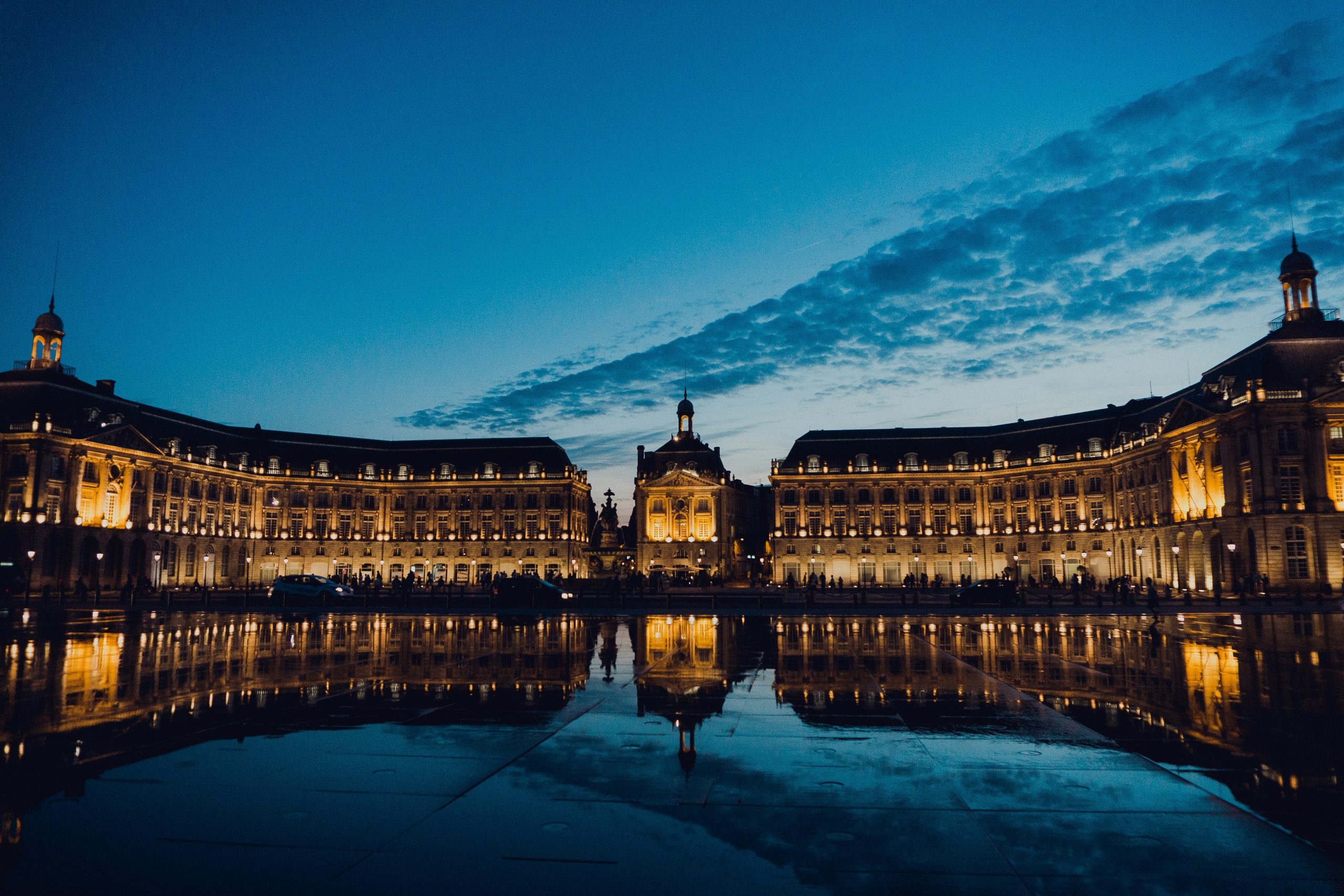
Photo by Juan Di Nella on Unsplash