Alain-Fournier’s Le Grand Meaulnes, published the year before the author died in action in 1914, is one of the most haunting and haunted novels ever written. Meaulnes, the restless, rebellious, risk-taking adolescent who is the book’s hero, stumbles quite by chance on a lost domain. He has bunked off school, and purloined a pony and trap with the intention of meeting his friend, the narrator Francois’s, grandparents at a railway station. He gets completely lost and ends up in a strange half-ruined château in the middle of nowhere, full of people, including children, in fancy dress. It seems they are random neighbours roped in to celebrate the return of the young châtelain Frantz de Galais from his wedding. Meaulnes meets and (of course!) falls in love with Frantz’s sister Yvonne. Frantz returns, long after the celebrations should have begun, distraught and without his fiancée, who has jilted him. Everything breaks up and Meaulnes has to return home, though from now on his only thought is how to rediscover Yvonne and the lost domain. Eventually they are reunited; but, as you may recall, the plot has many more twists, not all happy.
My recent return to Alsace after 38 years’ absence lacked some – in fact quite a few – of the elements of Alain-Fournier’s redolent tale. But the elements of romantic memory and rediscovery of an enchanted domain were not absent.
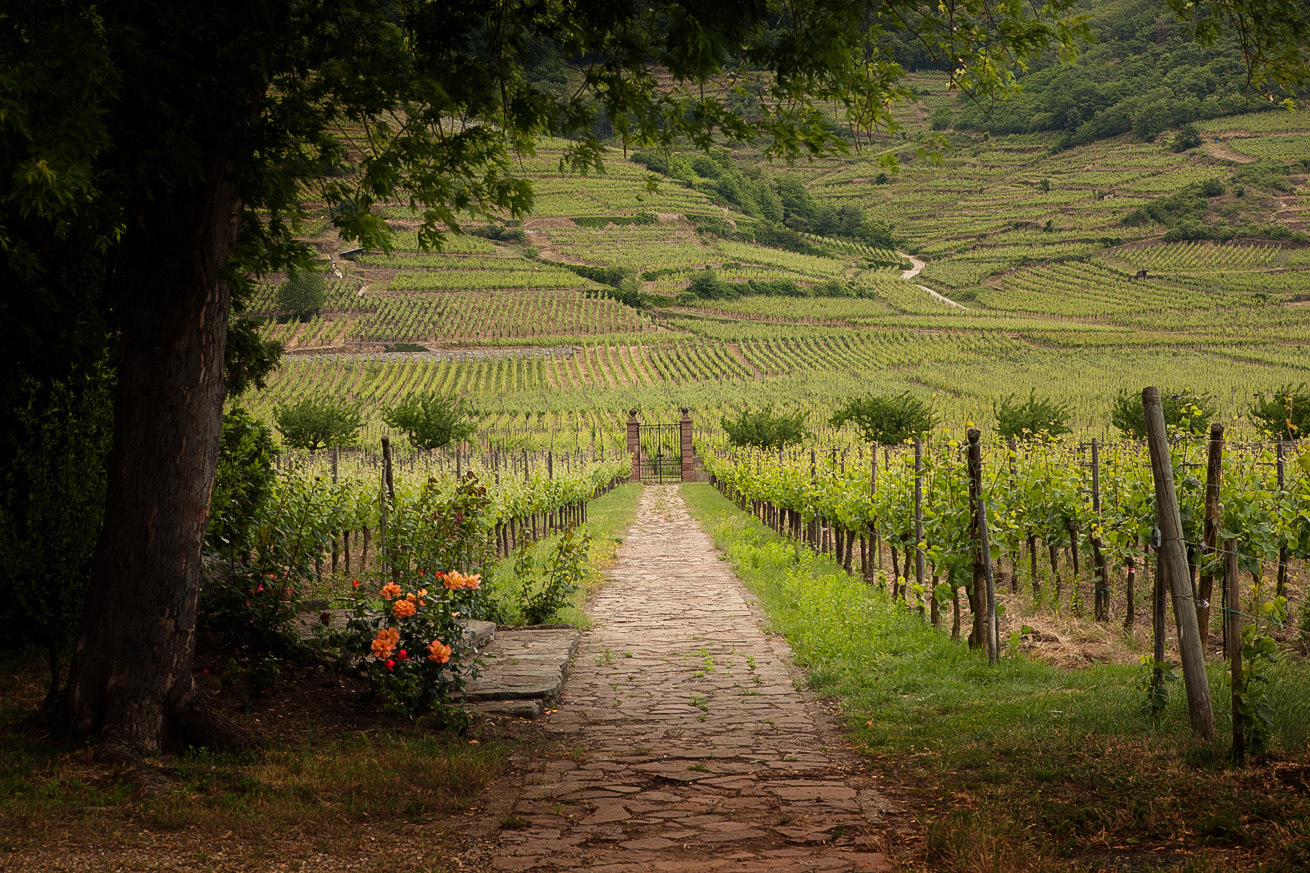
When I first visited Domaine Weinbach, the former monastic complex at the opening of the Kaysersberg valley in the Vosges, I had not been driving a pony and trap and was not exactly lost, though it was mid-February, the same season that Meaulnes’ adventure took place. But my recollection is of stumbling upon a rather perfect estate, not just beautiful but also homely and welcoming. In fact what I remember is being summoned into a great long many-windowed kitchen, and greeted by three women, the charming and imperious matriarch Collette Faller and her two brilliant daughters Catherine and Laurence. It was a bright morning, and on the long table there was still coffee and bread, which I was invited to share.
To say I fell in love sounds a bit corny, though I have never forgotten that meeting – and it might be difficult to say precisely what or who I fell in love with. Perhaps I fell in love with the whole place, the people, the atmosphere. Not to mention the wines, from the sandy Clos des Capucins surrounding the domain and the granitic grand cru Schlossberg towering above it, which, as it happened, I already knew and loved, as they were quite often opened at our family table.
It didn’t take Meaulnes 38 years to rediscover his lost domain (and Yvonne), and I feared that so much might have changed, including me, that the memory could seem irrecoverable. But I needn’t have worried. I found myself walking into the same, quite recognisable, long kitchen and being greeted by Catherine, now herself the matriarch.
Catherine now runs the estate with her sons Eddy and Théo, and it was Eddy who led us through a tasting of wines from the Grand Cru Schlossberg, the first Alsace grand cru to be established, in 1975, and dominated by Riesling (85-90%). This was after we had walked a little way through the vineyards to the edge of the steep hill. Looked at closely, as Frédéric Blanck explained, the Schlossberg, shared by 40 growers, is an intricate patchwork of cultivation, part-terraced, part not, with the occasional house and scrub-covered gullies where it’s too cold or steep to plant vines. It’s not so much a vineyard as a community and a history inscribed on a hill; I was reminded of Côte-Rôtie and Corton, but here the community bonds seemed even tighter. Blanck also commented that because the granite soil is so poor, it takes vines twenty years to produce really good fruit on the Schlossberg.
One thing that had changed since my last visit was that this was a multi-grower tasting. We sampled Rieslings from the Schlossberg going back to 2014 from Domaines Bernhard, Paul Blanck, Bott-Geyl, Kirrenbourg, Albert Mann and Maurice Schloech as well as Domaine Weinbach. The character of the Schlossberg, imposing, uncompromising, powerful, linear showed through in all of them. But I still felt, as I did all those years ago, that the Domaine Weinbach wines had a special grace and finesse, almost a gentleness, that played against the sternness of the Schlossberg. The atmosphere was collegiate, which felt especially important and even moving in Alsace, a region which has suffered so much conflict.
Another change, hugely welcome in my view, is the move towards organic and biodynamic viticulture. Domaine Weinbach has been cultivating vines biodynamically for 25 years; all the other growers who shared the Schlossberg tasting are either organic or biodynamic. And of course, as one grower pointed out, if you have decided to go in this direction, it won’t really work for your neighbour on the hill to still be using “conventional” chemical treatments.
It seems in fact that a quiet revolution has taken place in Alsace. Alsace is now the leading region in France for organic and biodynamic viticulture. Over a third of the Alsace vineyard is cultivated organically and getting on for 10% – including many of the most prestigious estates – biodynamically. Not just at Domaine Weinbach, but in many other places during my recent, very belated return visit, I felt a sense of rejuvenation and optimism. This was a refreshing counterblast to the general air of doom and gloom which seems to have settled on much (though not all) of the wine world. I put it down partly to an impressive younger generation, working with more imagination and freedom than was perhaps possible in earlier times, but also to something specific to Alsace. No other region in France, with the exception of Champagne, has been fought over so dramatically and tragically as Alsace. The most emotionally poignant wine we tasted on my trip was a 1943 Gewürztraminer from Jean Gipfel, still very much alive with an amazing pink-gold colour and a soft smokiness. That wine had survived the war, unlike the 50,000, French, American and German, who perished in the fierce battle of the Colmar pocket, in February 1945, eighteen months after it was harvested. And unlike Alain-Fournier, killed as an earlier war started, which would claim more than 15 million lives.
Photo courtesy of Domaine Weinbach