Riding the overground to The Wine Society’s latest panel on labour standards recently, I finished the final pages of Steinbeck’s The Grapes of Wrath.
If you’re yet to read it, the novel opens in 1930s Dust Bowl America and follows the Joad family as they migrate from their barren Oklahoma farm to California, where they have been promised bountiful harvests, work, and prosperity. The reality is very different, of course. When they finally reach their destination, they learn the picking jobs they were relying on have been deliberately over-advertised, suppressing wages and forcing desperate families to fight for the opportunity to pick fruit or cotton for starvation wages. Accommodation is non-existent or limited to an empty shack and a communal tap, and land-owners charge their workers inflated prices for meagre portions of basic foodstuffs, taking home a double profit and effectively forcing employees to work for free. The book is based on real-life events; it is estimated that over 2.5 million people were displaced during this period, with thousands dying of malnourishment and disease.
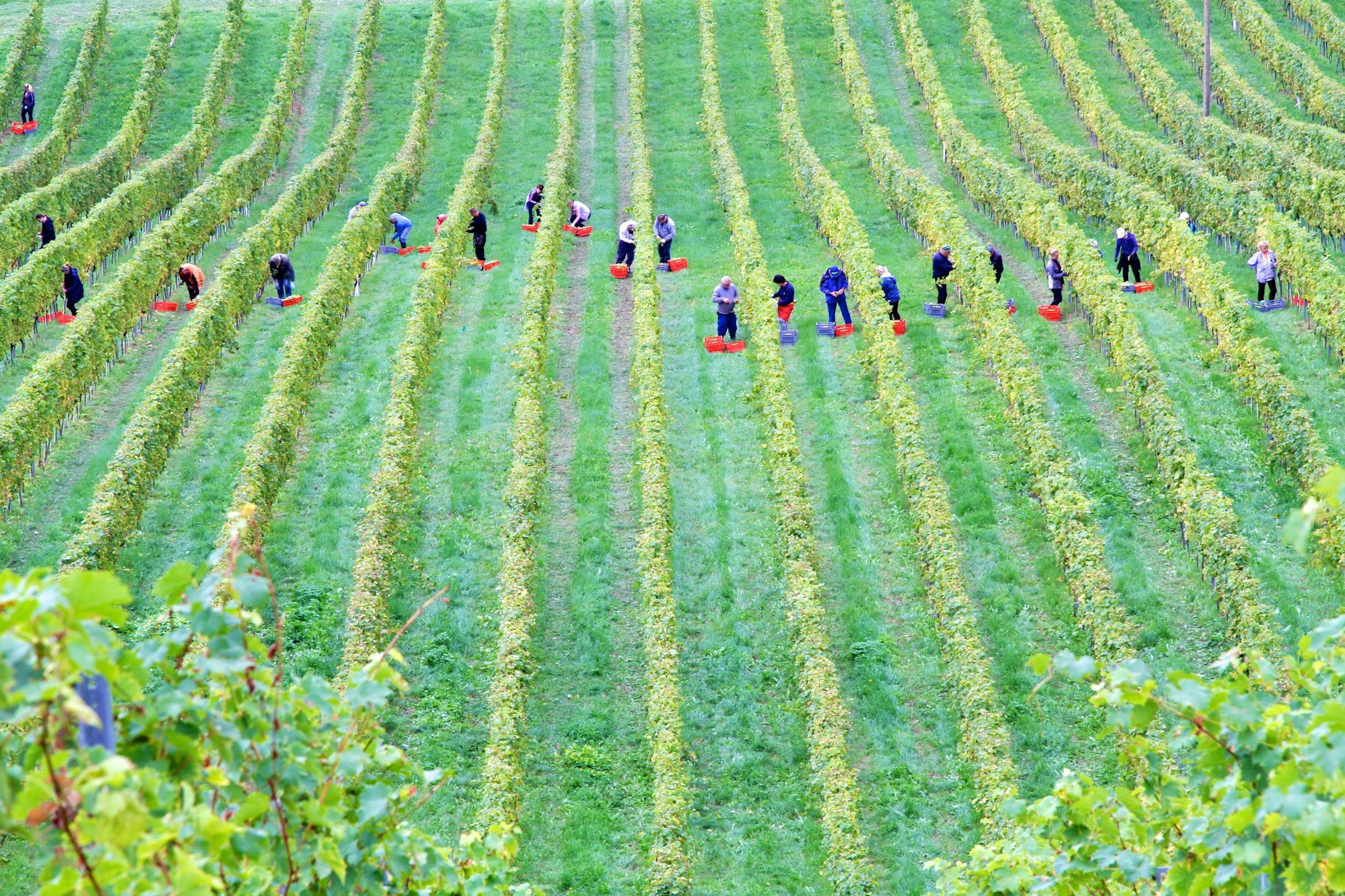
The Joad’s experience makes for difficult reading – all the more so because we know millions of people continue to endure a similar fate today. In fact, Weedpatch, the government camp the Joad family stays in when they arrive in California, is based on a real institution still open and accommodating Mexican migrant workers to this day. Many of the people living there rely on the kind of seasonal contracts the Joads crossed America for, and work long hours picking grapes that may eventually find their way into your favourite glass of Cali Chardonnay.
I don’t make this comparison to pass judgement on this particular camp, which I have never visited and was described positively in the novel, but to draw attention to the very real fact that human rights abuses are still impacting seasonal workers in wine regions all over the world. This is well-documented, so it astonishes me that this systematic maltreatment remains under-reported, poorly regulated, and almost entirely unchallenged by the trade and drinkers alike. I have written about this in a previous article for this site and, in 2018, journalist Ixchel Delaporte published Les raisins de la misère, a powerful non-fiction exposé of the 240km ‘corridor of poverty’ where seasonal workers are struggling to feed their families right next door to some of Bordeaux’s most prestigious chateaux. You don’t need to speak French to work out that Steinbeck’s novel inspired the title of her work.
All of this was very front of mind when I took my seat at The Wine Society panel, which, to my disappointment, was sparsely attended considering how rarely – if ever – the subject of workers’ rights is addressed by the UK wine trade. The event was a follow-up to a previous discussion aimed at getting the trade to “start talking”. This year, however, the focus was more active, with panellists providing insight on how to “transition from dialogue to delivery”: in the words of Jim Casy, a prominent character in Steinbeck’s novel, The Wine Society has decided it’s high time the UK trade “get[s] thikin’ about doin’ stuff that means somepin’.”
Chaired by sustainability expert Anne Jones of Limestone and Jones, the panel included Dom de Ville, Director of Sustainability and Social Impact at The Wine Society, Murray Barlow of Rustenberg Estate, and Allan Sichel, President of CIVB, the regional body for Bordeaux. Attendees learned that some progress has been made in recent years – for example, CIVB and the Nouvelle Aquitaine Prefet have developed free resources to help growers understand their responsibilities, and have rolled out a voluntary charter, now signed by over 110 companies, where signatories declare their commitment to comply with French labour laws. However, although ‘most people and employers are well-intentioned’ many would still, in Sichel’s words, ‘rather remain below the radar’ for fear of being ‘stigmatised’.
And why would producers risk putting their heads above the parapet when so few retailers, sustainability qualifications, or drinkers require them to do so? According to Barlow, ‘the UK wine trade hasn’t really, save one or two key players, taken a stand. It should be standard practice. In textiles, players take this seriously, so why can’t the wine trade? We should be asking as consumers: why isn’t the trade doing more?’
It is doing more in other countries. Sweden’s Systembolaget – a government-owned chain with an exclusive monopoly over alcohol sales – has already shown how transformative retailer intervention can be. Their site provides numerous resources informing drinkers about social responsibility and has integrated search criteria enabling customers to filter producers according to their sustainability and human rights credentials. By 2030, all suppliers will need to comply with their Code of Conduct for good working conditions and human rights: ‘remain[ing] below the radar’ won’t be an option for much longer.
According to the panel, however, the UK trade is lagging behind. When de Ville transitioned from fashion to the wine industry four years ago, he was ‘surprised how little this topic was talked about, particularly regarding seasonal workers.’ Tasked with improving environmental and social responsibility at The Wine Society, he soon discovered that most UK retailers and sustainability qualifications ‘don’t really address the needs of temporary workers’ and that ‘no tools existed in the wine industry to help producers.’ Furthermore, any information that was available tended to focus on other sectors, and was ‘high level and quite complicated […] There was nothing for those small to mid-sized producers hiring 50 seasonal workers every year.’
What can retailers do?
These discoveries prompted The Wine Society to develop, in de Ville’s words, their own 5-step ‘simple framework’ inspired by ‘a standard human rights due diligence approach’ to help producers of all sizes assess and manage risks:
1) Make a commitment and assign a responsible person within your business
2) Assess where the risks are in your supply chain
3) Make a plan to address the most urgent risks
4) Share findings and plans with The Wine Society (or other supplier)
5) Establish a pathway of continuous improvement
De Ville stresses the importance of supporting producers throughout their transition. As well as making information and resources freely available in six languages, they have hired a dedicated resource to follow producers’ progress, answer questions, and provide additional guidance where necessary. The Wine Society is urging all their own label and key suppliers to meet their social responsibility requirements by the end of 2026, at which point they plan to roll out the same standards across the rest of their 800-strong portfolio. Very soon, social responsibility will be a gateway to entry.
Barlow is in favour of this firm approach: ‘to improve a value chain you need carrots as well as sticks […] but without a stick it won’t start.’ The Barlow family owns Rustenberg Estate and has been working on improving workers’ rights for many years. As part of this, the estate is a certified member of the Wine and Agricultural Ethical Trade Association, or WIETA, which is one of the only qualifications to thoroughly interrogate the treatment of seasonal employees and sets rigorous standards regarding wages, working hours, health and safety, housing, child labour, and more.
‘What many people forget’, added Barlow, is that good practice also ‘comes with opportunities for reduced costs. When your employees feel empowered, you suddenly have a whole army of people reporting to and helping management’ – not to mention high-profile distribution avenues with ethically-minded companies.
De Ville and his team are working hard to foster more opportunities, or carrots, to reward compliant wineries. Earlier this year, they launched their Society’s Pioneers range, ‘a collection of wines from producers going above and beyond in their care for land, people and craft.’ These producers, advertised as ‘wines to feel good about,’ receive additional marketing support and are highlighted prominently on The Wine Society’s website, exposure which, according to De Ville, has already led to ‘a definite uptick in sales.’
How can you make a difference?
In De Ville’s words, for all this is to make a material difference to the hundreds of thousands of temporary workers set to pick the 2026 harvest in a few months’ time, ‘other retailers need to do the same’ – and there is no greater incentive for this than consumer buy-in.
If you shop with The Wine Society, prioritise their Pioneers range and take every opportunity to share the inspiring work of these ethical producers with your friends and family. When you buy wine elsewhere, be sure to ask your preferred retailers to recommend an ethical bottle made with social responsibility in mind. What we choose to buy makes a difference, and wine should be something to feel good about, after all.
Photo by Matthias Mitterlehner on Unsplash